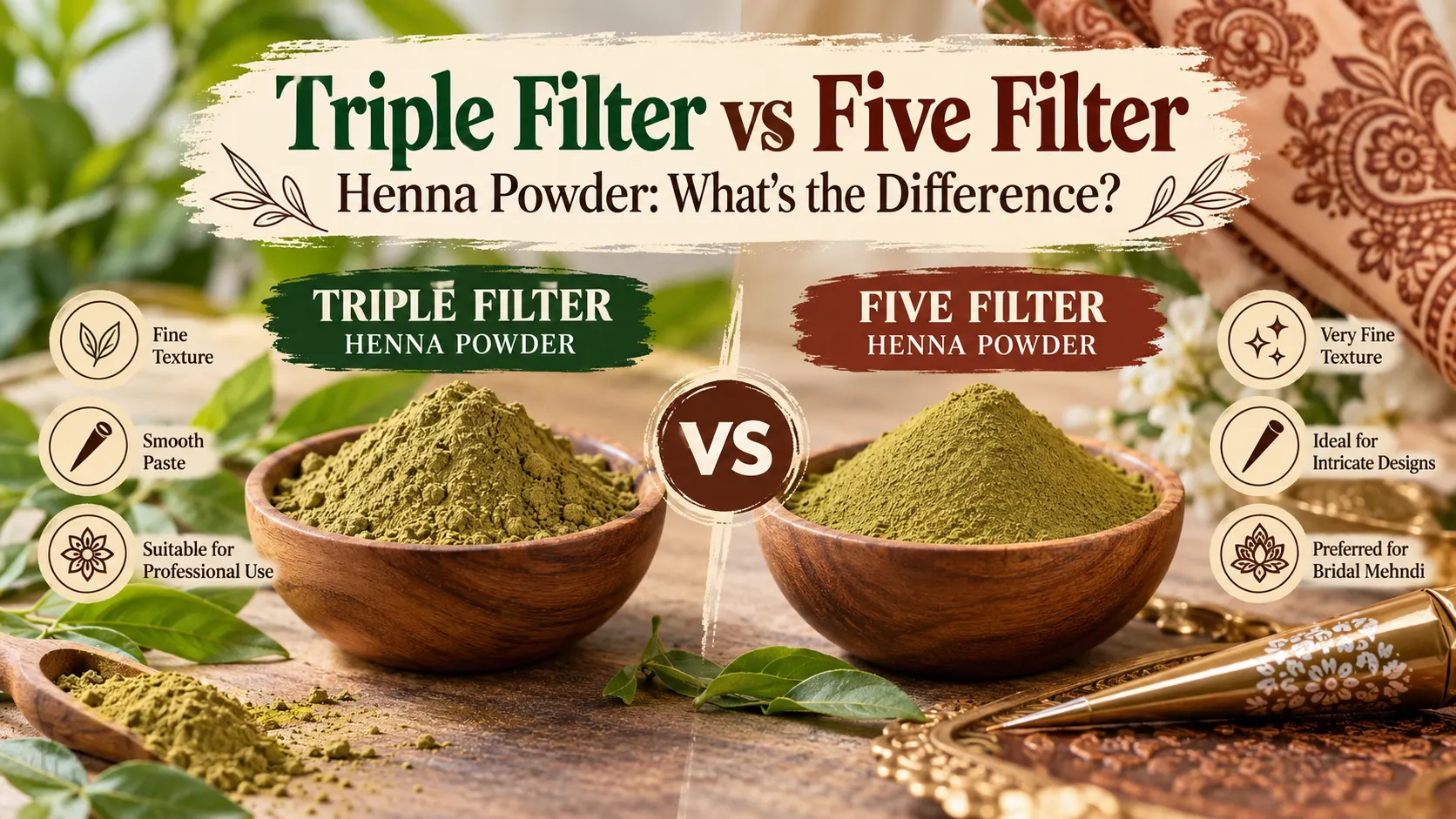
When choosing henna powder for professional mehndi application, you may come across terms such as triple filter henna powder and five filter henna powder. At first, the difference may sound simple: one is filtered three times and the other five times. However, for mehndi artists, henna businesses, and regular users, the practical difference is mainly about particle refinement, paste consistency, cone flow, and suitability for detailed application.
A finely processed henna powder can make preparing and applying henna paste easier, particularly when working with narrow cone tips and intricate bridal designs.
In this guide, we explain the difference between triple filter and five filter henna powder, what filtration means, where each type can be useful, and what to consider when selecting henna powder for professional use.
What Does Filtered Henna Powder Mean?
Natural henna powder is produced from the dried leaves of the henna plant (Lawsonia inermis). After suitable leaves are harvested and dried, they are ground into powder.
Grinding alone, however, may not produce the consistency required for professional body-art applications.
Henna powder can contain particles of different sizes as well as small amounts of fibrous plant material. Processing and sieving help remove larger particles and create a finer, more uniform powder.
The term filtered henna powder generally refers to henna that has undergone additional sieving or filtration during processing.
Finer powder can be particularly useful when preparing paste for applicator cones because large particles and plant fibres can interfere with smooth flow through a very small cone opening.
It is important to remember that filtration primarily describes physical refinement. It should not automatically be interpreted as proof of purity, dye content, freshness, or overall quality. Those factors depend on the raw henna leaves, processing practices, storage conditions, and other quality controls.
What Is Triple Filter Henna Powder?
Triple filter henna powder generally refers to henna powder that has undergone multiple stages of fine sieving or filtration, commonly described by suppliers as three filtration stages.
The objective is to achieve a fine and relatively uniform powder suitable for smooth paste preparation.
Triple filtered henna can be used by:
- Professional mehndi artists
- Henna cone makers
- Bridal artists
- Henna studios
- Learners and practicing artists
- Businesses preparing henna-based products
When properly processed, finely filtered powder mixes readily with liquid and can produce a smooth paste suitable for cone application.
Advantages of Triple Filter Henna Powder
One of its main benefits is workability.
A sufficiently fine powder can help reduce coarse particles in the prepared paste. This is particularly important when an artist needs predictable henna flow for lines, curves, leaves, flowers, paisleys, and other design elements.
Triple filtered powder can therefore provide a practical balance between refinement and everyday professional use.
Actual performance will still depend on the quality of the henna itself and how the paste is prepared.
What Is Five Filter Henna Powder?
Five filter henna powder is generally marketed as henna that has undergone additional stages of fine filtration or sieving compared with products described as triple filtered.
The intention is to obtain an especially fine and uniform powder with minimal coarse plant material.
This level of refinement can be attractive to professional artists working on designs where fine cone control and intricate detailing are particularly important.
Five filtered henna powder may therefore be considered for:
- Intricate bridal mehndi
- Fine-line henna designs
- Detailed Arabic and Indian patterns
- Professional cone preparation
- Precision-focused henna work
- Commercial henna cone production
A finer powder can help produce a smoother paste, assuming the powder is mixed, rested and strained appropriately.
Triple Filter vs Five Filter Henna Powder: Key Differences
The most obvious difference is the claimed level of filtration, but that can influence how the powder behaves during paste preparation and application.
|
Feature |
Triple Filter Henna Powder |
Five Filter Henna Powder |
|
Filtration |
Multiple filtration stages |
Additional/finer filtration stages |
|
Powder texture |
Fine |
Very fine |
|
Paste consistency |
Smooth when prepared correctly |
Designed for highly smooth consistency |
|
Cone application |
Suitable for professional use |
Particularly suited to precision work |
|
Fine detailing |
Good |
Often preferred for very intricate work |
|
Typical use |
General and professional mehndi |
Bridal and precision-oriented mehndi |
|
User profile |
Beginners to professionals |
Professional/detail-focused artists |
These descriptions should be treated as general guidelines rather than universal industry specifications. “Triple filter” and “five filter” are not standardized grades across every henna manufacturer. Processing methods, sieve specifications and terminology can vary between suppliers.
For this reason, buyers should evaluate more than the filtration label alone.
Does More Filtration Mean Better Henna?
Not necessarily.
Five filter henna may be more finely processed than triple filter henna from the same manufacturer, but the number of filtration stages alone does not determine overall henna quality.
High-quality henna starts with good raw material.
Important factors include:
Quality of Henna Leaves
The characteristics of the leaves used to produce the powder significantly affect the finished product.
Henna from Sojat, Rajasthan, is well known within India's henna industry, and the region is an important centre for henna cultivation and processing.
Freshness
Henna is a botanical product, and appropriate processing and storage matter. Exposure to unsuitable heat, moisture and storage conditions can affect product quality over time.
Particle Size
Fine and consistent particle size is especially useful for body-art henna because it helps with paste preparation and application through fine-tipped cones.
Storage and Packaging
Henna powder should be protected from moisture and excessive heat. Suitable packaging and storage help maintain the condition of the powder before use.
Purity and Product Specifications
For professional or commercial sourcing, buyers should ask suppliers about ingredients, product specifications and relevant quality documentation rather than assuming filtration terminology establishes purity.
Which Henna Powder Is Better for Cone Making?
Both triple filter and five filter henna powders can potentially be used for making henna cones if they are sufficiently fine and intended for body-art applications.
For everyday professional cone preparation, triple filter henna powder can provide the refinement needed for smooth application.
For artists who regularly create extremely detailed designs using very fine cone openings, a five filter henna powder may offer an advantage in particle uniformity.
However, powder selection is only part of the process.
Cone performance also depends on:
- Henna-to-liquid ratio
- Paste consistency
- Mixing technique
- Resting or dye-release process
- Additional straining
- Cone material
- Cone opening size
- Storage conditions
Even finely filtered powder will not compensate for incorrectly prepared paste.
Which Is Better for Bridal Mehndi?
Bridal mehndi frequently involves highly detailed patterns covering large areas of the hands, arms, feet or legs. Artists may spend several hours creating closely spaced lines and intricate motifs.
For this kind of work, paste consistency and controlled flow become especially important.
A finely processed five filter henna powder may be useful for artists who prioritize extremely smooth application and precision.
That does not mean triple filter powder cannot be used for bridal work. Experienced artists can achieve detailed results with high-quality triple filtered powder as well.
The appropriate choice depends on the artist's technique, cone opening, paste recipe and preferred consistency.
What Should Professional Mehndi Artists Look for When Buying Henna Powder?
Instead of choosing a product solely because it says “triple filtered” or “five filtered,” evaluate the overall product.
Consider the following:
Fine texture: The powder should be sufficiently fine for its intended application.
Consistency: Professional users and businesses generally benefit from consistent batches and predictable processing standards.
Freshness: Ask about manufacturing, packaging and recommended storage.
Ingredient transparency: Know what you are buying, particularly when sourcing henna for body-art applications.
Reliable supplier: Professional artists and businesses need dependable supply, especially when purchasing larger quantities.
Packaging: Appropriate packaging helps protect botanical powders from moisture and environmental exposure.
For wholesale buyers, additional considerations can include minimum order quantities, packaging formats, private-label options, production capacity and export support.
Triple Filter or Five Filter: Which Should You Choose?
There is no single answer for every user.
Choose triple filter henna powder when you need a finely processed powder suitable for general professional mehndi work, cone preparation, practice and a variety of designs.
Consider five filter henna powder when extremely fine particle refinement and precision application are priorities, particularly for detailed bridal or professional artwork.
If you are purchasing commercially, it can be useful to test samples from the same supplier under your normal paste recipe and application conditions. Comparing actual performance is often more informative than relying only on filtration terminology.
Sourcing Filtered Henna Powder from Sojat
Sojat in Rajasthan has a longstanding association with India's henna trade and is an important sourcing region for henna leaves and powder.
Prem Henna Traders supplies henna products from Sojat, Rajasthan, for professional, wholesale and commercial requirements.
The range includes filtered henna powders and supporting products used by mehndi professionals, along with options for businesses looking for bulk supply, wholesale sourcing and private-label solutions.
When sourcing henna commercially, buyers should discuss their intended application, desired powder characteristics, packaging requirements and order quantities with the supplier before selecting a grade.
Frequently Asked Questions
What is triple filter henna powder?
Triple filter henna powder generally refers to henna that has undergone multiple fine-sieving or filtration stages to produce a refined powder suitable for smooth paste preparation and henna application.
What is five filter henna powder?
Five filter henna powder generally refers to henna that has undergone additional fine filtration to achieve a very fine, uniform texture. It is commonly positioned for professional and precision-focused mehndi applications.
Is five filter henna better than triple filter henna?
Not automatically. Five filter henna may provide finer particle refinement, but overall quality also depends on the henna leaves, freshness, processing, purity, packaging and storage.
Can triple filter henna be used for bridal mehndi?
Yes. A high-quality triple filtered henna powder can be suitable for bridal mehndi when correctly prepared. Artists who use exceptionally fine cone tips may prefer a more finely filtered powder.
Which henna powder is best for professional mehndi artists?
A fine, fresh and consistently processed henna powder intended for body art is generally preferable. The choice between triple and five filter products depends on the artist's application technique and required level of refinement.
Final Thoughts
The main difference between triple filter and five filter henna powder is the degree of physical refinement represented by the supplier's filtration process.
Triple filtered henna can be an excellent option for everyday professional mehndi and cone preparation, while five filtered henna may be particularly useful when very fine texture and precision application are required.
However, more filtration should not automatically be confused with better overall henna. Raw-material quality, freshness, processing, particle consistency, purity, packaging and storage all matter.
For professional artists and wholesale buyers, the most reliable approach is to consider the complete product specification and test how the powder performs for the intended application
 100% Natural Henna